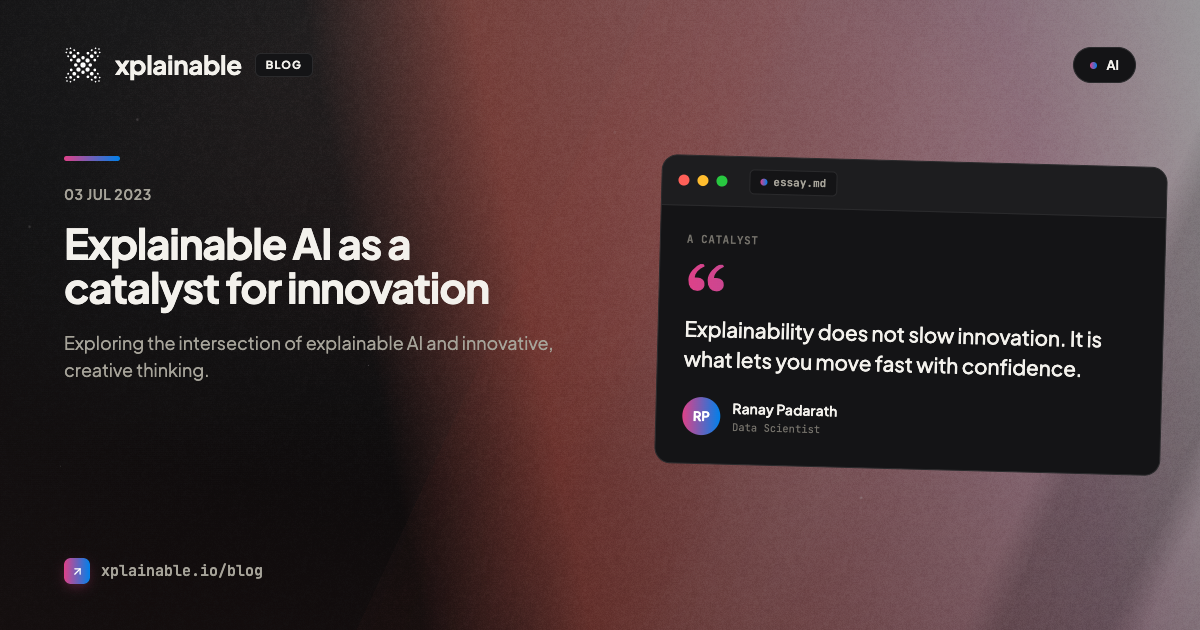
Explainable AI as a Catalyst for Innovation and Creativity
Exploring the Intersection of Explainable AI and Innovative Thinking
In the last year, Artificial Intelligence (AI) has reached new heights in capability, popularity and usage around the world. As individuals become familiar with popular services like ChatGPT, many more people are beginning to understand how AI will profoundly change our lives. AI technology will have an impact in many areas, but especially at work. Many industries and business functions have been using AI tools for some time already. But as the latest generation of cutting-edge AI technology captivates the world, we will see a rapid expansion and penetration of AI tools in business.
Today's enterprise-technology relationship
Throughout the Information Age, it has been common to see consumers adopt new technology before the enterprise sector. For example, consumers were using cloud storage services like Dropbox long before organisations migrated from their on-premise servers to SharePoint in the cloud. This is because new technology carries significant costs and risks before returns are ever made on that investment. That's why we see enterprises wait for new technologies to mature, which in-turn reduces the costs and de-risks investment. Typically, consumer adoption accelerates this maturation process.
Future success is defined by the pace of technology adoption
However, for the last 20-30 years we can also observe an opposing incentive - that is - organisations which adopt and integrate new technology in their businesses faster, succeed more often. Accenture's 2021 Make The Leap, Take the Lead reported that leaders in enterprise technology are growing 5x faster (up from 2x) through technology investment over the COVID-19 period. This phenomenon will be even more apparent as we enter the AI era. AI will have significant impacts on productivity, innovation and problem solving. The organisations that leverage AI more swiftly, more effectively and more reliably will widen the gap between themselves and their competition.
Bridging the technology paradox
How can organisations navigate this technology paradox as it relates to AI technology? Is it possible to deploy effective AI solutions swiftly and reliably, while responsibly managing costs and risks?
This is where Explainable AI (XAI) tools can help. XAI tools allow technical stakeholders understand how effective and reliable their AI models really are. With this understanding, business stakeholders can use AI tools to drive innovation and foster creativity.
Organisations that use XAI tools can make informed assessments about the AI tools they are using, whether their AI tools are producing business value or generating intolerable business risk. With all the understanding that XAI tool provide, organisations can more swiftly and confidently implement new AI technologies, knowing they have the means to manage cost-effectiveness and risk. This makes XAI tools a crucial part of any organisation's overall suite of AI technologies.
Explainable AI can drive innovation
When most people think about AI in business, they usually think of organisations leveraging machine learning to more effectively sell products or services to customers. They might imagine marketing teams using AI tools to better understand customer behaviour or product teams integrating AI features into their products. You could describe this behaviour as using AI to achieve an external business outcome.
One area of promise is the use of AI tools within an organisation to achieve internal business outcomes. AI tools, in concert with XAI tools present a compelling opportunity for organisations to better understand, de-risk and optimise their business. Examples include:
- Using AI systems in manufacturing and process engineering to identify inefficiencies, reduce process duration or inform resource allocation.
- Using AI systems to execute repetitive, low-cognitive tasks so that human capital can work on complex, novel or cognitive-heavy tasks.
- Using AI systems to prioritise, track and dynamically allocate customer service representatives in customer support function.
Implementing AI systems that perform the tasks above is not guaranteed to produce business value. But using XAI tools alongside these AI systems equips organisations with the necessary information about how performant their AI systems are.
These examples are particularly salient in the context of economic uncertainty and looming recession. During slow business cycles, many organisations assess the productivity of their operations - particularly technology projects - to identify areas for cost-reduction. XAI tools can support this effort by providing organisations with important data about the effectiveness of their AI tools.
Explainable AI fosters creativity
Organisations collect a lot of data from its customers and use that data to make predictions about their customers to more effectively sell products or services. Organisations that are able to leverage data effectively are likely to be more successful than those that don't. It is no coincidence that today's most valuable organisations are ones that sell digital products and services in which data is a core part of their business.
In a world before AI, data scientists analysed a small subset of an organisation's data to inform business decisions. In today's AI world, data scientists and engineers build AI systems to analyse much more data and make AI-driven predictions that inform a wide array of business decisions of greater strategic importance. There are many ways in which organisations currently use data and AI to make predictions.
However, in order to be competitive, organisations must go beyond mature AI solutions. Organisations must invest in their AI capability, empowering their teams to make more predictions, over a greater breadth of data, with greater accuracy. Armed with AI-driven predictions, organisations will be able to generate creative solutions to challenging business problems. Its difficult to forecast what solutions may be discovered, but there are opportunities in many business functions including AI-managed customer engagement, AI-optimised supply chains logistics and AI-powered product features. Investing in these AI systems can be risky, which is why XAI tools will be crucial to any AI implementation.
Increasingly, any organisation - even those whose core product or service is not digital by nature need to leverage data to make AI-driven predictions. These predictions must be reliable and must be explainable to business stakeholders that make strategic business decisions. XAI tools help data scientists and AI engineers not only optimise their AI models to increase reliability, but help technical stakeholders communicate, justify and advocate for AI-generated predictions that inform strategic business decisions.
Conclusion
Businesses must embrace new technology to remain competitive and succeed long-term. AI will be the most important technology in the coming years and decades, but AI investments can be expensive, risky and don't always deliver business value. XAI tools can help business assess the effectiveness and reliability of their AI investments. XAI tools drive innovation internally and foster creativity in products and services they sell in the market. This makes XAI tools a must-have in any organisation's suite of AI tools.