Xplainable Now Connects Directly to Shopify: Turn Your Store Data into Actionable Intelligence
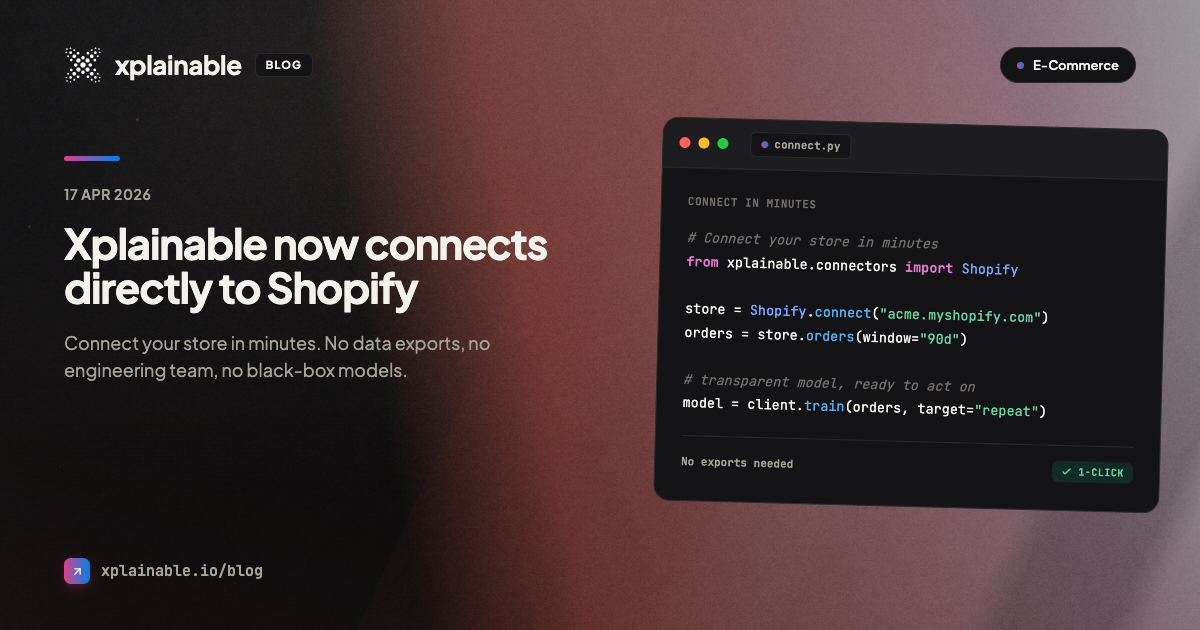
Connect your Shopify store in minutes. No data exports, no engineering team, no black-box models. Just transparent, lever-ready insights from the data you already have.

Most Shopify merchants are sitting on a goldmine of customer data: orders, products, purchase history, customer profiles. The problem isn't the data. It's knowing what to do with it.
Today, we're announcing that Xplainable connects directly to your Shopify store. No CSV exports. No engineering sprints. Just a secure connection that brings your commerce data into a platform purpose-built for transparent, actionable machine learning.
Why This Matters for Merchants
Customer acquisition costs in e-commerce have surged over 222% in the last five years. Retaining the customers you already have costs 5 to 25 times less than finding new ones. Yet most merchants still rely on gut feel, blanket discounts, and one-size-fits-all campaigns.
Three out of four e-commerce business owners now use AI tools, but only 23% of AI implementations produce measurable ROI within the first year.
The gap isn't adoption. It's understanding. When a model tells you a customer will churn but can't tell you why, you're left guessing at the intervention. Xplainable closes that gap by making every prediction fully transparent.
Four Levers Every Commerce Merchant Leaves on the Table
Each of these use cases maps directly to data that already lives inside your Shopify store. Xplainable models it with explainability-first machine learning and turns it into priced, actionable levers.
1. Churn Prediction and Prevention
Identify which customers are silently drifting away, and crucially, why. Price sensitivity, category fatigue, delivery friction, inactivity decay: each factor is flagged with the exact contribution it makes to churn risk.
The lever: Target the bottom quintile by predicted lift, not the top by risk score. Lowest cost per retained dollar.
Instead of blasting your entire list with a "We miss you" email, you can see that Customer A is churning because of delivery friction while Customer B is price-sensitive. Different problems, different interventions, better results.
With Xplainable's scenario analysis, you can go further: ask "what would it take to move this customer from high-risk to low-risk?" and see exactly which factors need to shift, and by how much.
2. Discount Intelligence
Stop blanketing your list with a 20% code. Xplainable models each customer's discount sensitivity against their predicted order value and helps you decide, at a row level, whether a coupon is worth the margin hit or actively destructive.
The lever: Right-size every code, from free shipping to 25%, against predicted lift and cost basis.
A high-value repeat buyer who would have purchased anyway doesn't need a 20% discount. A price-sensitive browser on the fence might convert with free shipping alone. The model tells you the difference, and the scenario analysis lets you simulate the impact before you send a single email.
3. Customer Lifetime Value
Not all customers are created equal, and not all high-spenders are high-value when you account for acquisition cost, return rate, and support load. Xplainable's regression models predict LTV with full transparency into what's driving it.
The lever: Allocate acquisition and retention spend proportionally to predicted lifetime value, not last-month revenue.
When you can see that a customer's predicted LTV is driven primarily by product category mix and order frequency rather than average order value, you make smarter decisions about where to invest.
4. Win-Back Campaigns
Lapsed customers aren't all equal. Some respond to a reminder, some need a loss-leader bundle, and some are gone for good. Chasing all of them equally destroys margin. Xplainable models the intervention, not just the audience.
The lever: Match the offer to the customer, based on modelled response and margin cost of each intervention.
How It Works: From Shopify to Lever-Ready Scores in Days
The pipeline is straightforward, and you don't need a data science team to run it. Xplainable's agentic training pipeline handles the hard parts: an AI agent analyses your raw Shopify data, recommends a target variable, engineers the right features, prepares the data, and trains the model. You stay in control with approval checkpoints at every key decision, and you can chat with the agent to refine its approach.
The critical difference is step 2. Traditional ML tools expect you to arrive with a clean, feature-engineered dataset. Xplainable's agent starts from your raw Shopify tables and does the heavy lifting: defining what "churn" means for your store, building recency-frequency-monetary features, identifying which product categories matter, and flagging data quality issues. You just approve the decisions.
What Data Does Xplainable Pull from Shopify?
Once connected, you get access to these tables directly inside Xplainable:
- Products and product variants: your full catalogue with pricing, inventory, and metadata
- Orders: complete order history with line items, totals, and fulfilment status
- Customers: profiles, tags, order counts, and spend totals
- Inventory items: stock levels and tracking data
- Marketing events: campaign performance tied back to revenue
- Staff members: team activity and attribution
- Gift cards: issuance, usage, and balance tracking
You can save any of these as a static dataset for model training, or create a live dataset that stays in sync with your store.
Why Explainability Matters for Commerce
Most AI tools for e-commerce are black boxes. They output a score or a recommendation, but they can't tell you what's driving it. That creates three problems:
-
You can't act on what you don't understand. A churn score of 0.87 is useless without knowing whether it's driven by price sensitivity or delivery experience.
-
You can't trust what you can't verify. If the model says "discount this customer 25%" but can't explain why, how do you know it's not just eroding margin?
-
You can't improve what you can't decompose. When a campaign underperforms, transparent models let you trace back to exactly which lever didn't move. Black boxes just shrug.
Xplainable's models are inherently interpretable, not post-hoc approximations bolted on after the fact. Every prediction comes with a full breakdown of feature contributions at three levels: global (the whole model), regional (customer segments), and local (individual customers).
And with scenario analysis, the explanations become actionable. Instead of just seeing why a customer scored the way they did, you can explore what would need to change to move the score. That turns a static prediction into a decision-support tool.
Getting Connected Takes Minutes
Here's what the setup looks like:
- In Xplainable, navigate to Datasets > Integrations and click Create new source
- Select Shopify from the integration catalogue
- Enter your store's URL (e.g., my-store.myshopify.com), your app's Client ID, and Client Secret
- Click Test and Connect
That's it. Your Shopify tables appear immediately. From there, you can preview the data, save tables as datasets, and start the agentic training pipeline.
No data warehouse. No ETL pipeline. No engineering tickets.
Ready to See What Your Shopify Data Can Tell You?
The Shopify integration is available now. Connect your store, let the agentic pipeline build your first model, and see exactly which levers are worth pulling, with every prediction explained.
Book a demo to see it in action, or log in to Xplainable and connect your store today.